

Source Tracking
Create sources, assign them to campaigns, and compare contact, transfer, sale, and cost metrics by channel.
A source is the attribution key careCycle attaches to every lead and call. Tag everything coming into your agency with the right source, and your reporting answers the question that actually matters: which channels produce members, and which just produce phone bills.
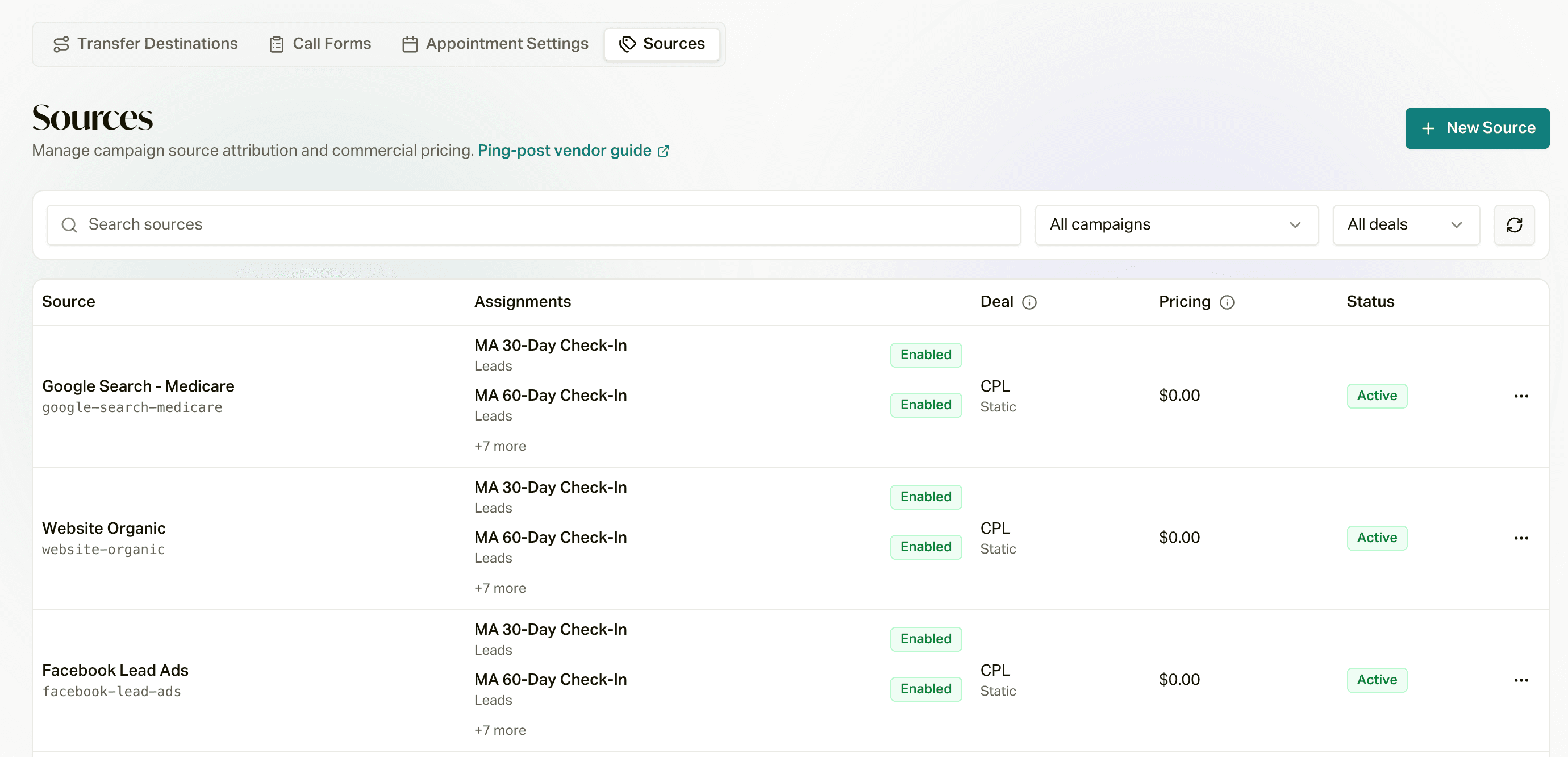
Create and Manage Sources
Sources live in Configure in the sidebar, under the Sources tab. Create one source per distinct channel or vendor: each lead vendor, each call vendor, your website, each mail drop. The more precisely you split them, the more useful your performance comparisons become.
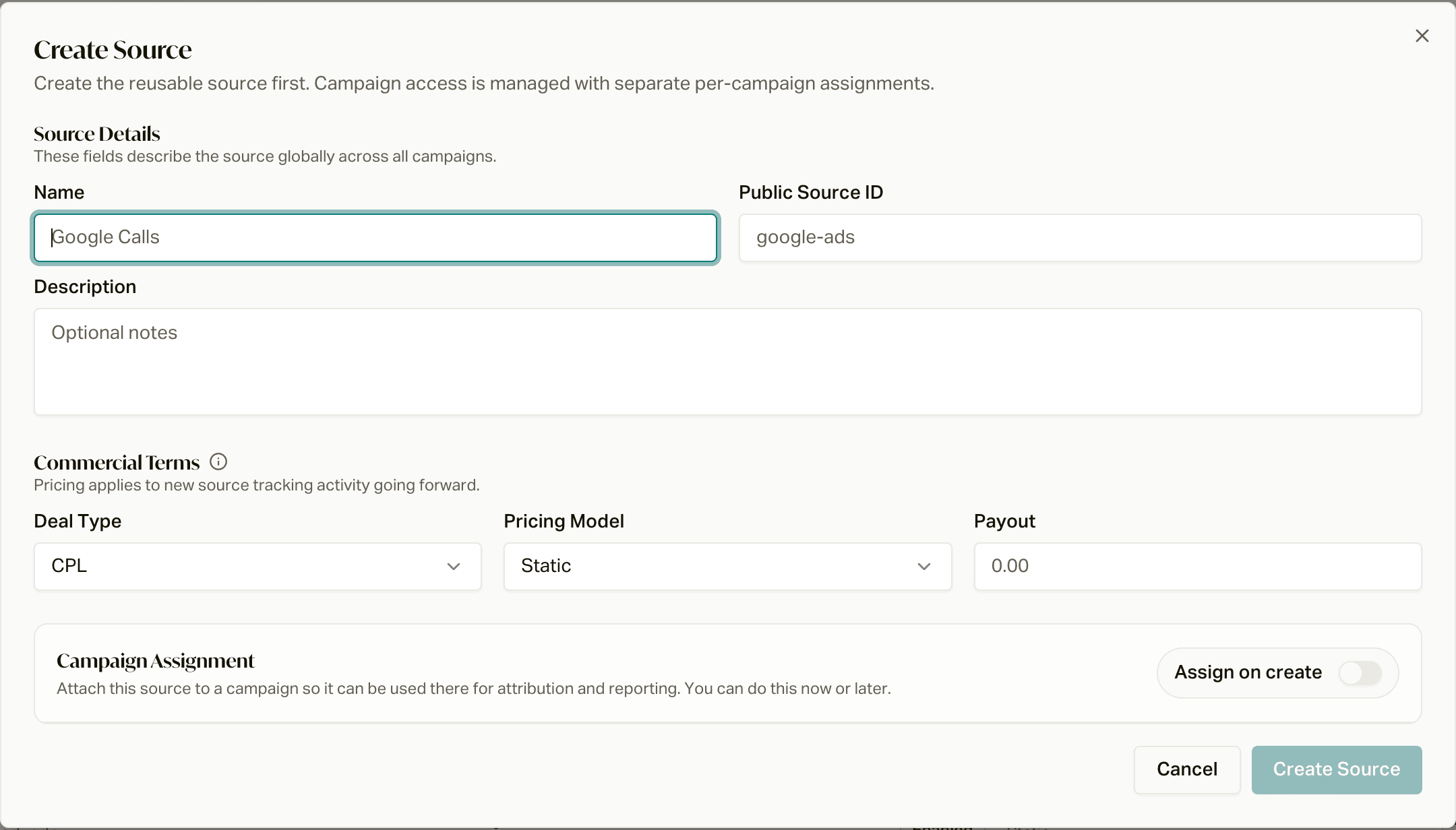
Each source carries:
- Name and Source ID: the Source ID is the public identifier vendors send
as
source_idon pings orsourceIdwhen uploading lead records. - Deal type: CPL (cost per lead or call) or CPA (cost per acquisition after conversion).
- Pricing model: static (fixed lead cost), dynamic (per-lead cost), duration (call payout after a duration threshold), or flat and percentage CPA payout models, with the payout, commission per sale, lead cost, and duration threshold to match. Pricing applies to new source activity going forward, and it is what powers the spend and CPA columns in reporting.
- Campaign assignments: each assignment ties the source to a campaign with an explicit acquisition type: lead records or live inbound calls. Live calls use an existing campaign-owned tracking number for attribution. Purchase any additional numbers in the campaign's Calling numbers settings before attaching them. Assignment does not purchase numbers or change call handling.
In campaign configuration, Voice AI and outbound agent queues offer lead-record sources; inbound agent queues offer live-call sources. Each supports CPL or CPA terms. The general Sources editor and API also support explicit lead and call assignments independently of campaign direction.
Public Source ID is optional when creating a source. Leave it blank to generate a unique identifier automatically, or supply the identifier your integration uses.
Shared source pricing must support every attached acquisition type. Disabling an assignment keeps it attached; detaching removes it from active configuration while preserving its historical attribution. Connecting a lead-record source in Voice AI or outbound agent queue campaign configuration creates a source-specific Lead Created enrollment automation. New leads attributed to that source enter the campaign through the existing automation engine. Existing leads are not enrolled retroactively. Each source has one automatic lead destination. Selecting a different destination asks you to move future lead submissions; existing customers remain in their current campaigns. General attribution assignments do not silently create enrollment rules. Disabling or detaching the source assignment disables its generated automation; re-enabling or reattaching reuses it. Live-call assignments do not create lead enrollment automations.
Connecting a call source
Inbound agent queue setup requires a dedicated tracking number. Choose an existing queue-owned number, or search for a new one and confirm purchase on Save. The number is purchased, registered, assigned to the queue, and linked to the source. The source is not enabled until assignment completes. Numbers beyond the plan's included count are billed monthly. If purchase outcome is uncertain, setup needs review and will not buy another number automatically. Purchased numbers remain owned by the organization if later assignment fails.
Stopping source intake disables its assignment. It does not release or reroute the number: the number remains connected to the queue, while new calls no longer use that source assignment for tracking. Existing work and history are preserved.
Sources created without a campaign
Creating an unattached source establishes its public identifier and commercial terms. It does not purchase a phone number or start automatic lead enrollment. The confirmation shows Not connected and links to campaign setup. Lead uploads can carry its identifier for attribution; connect it in campaign configuration to start enrollment or configure a call tracking number.
The Source Performance View
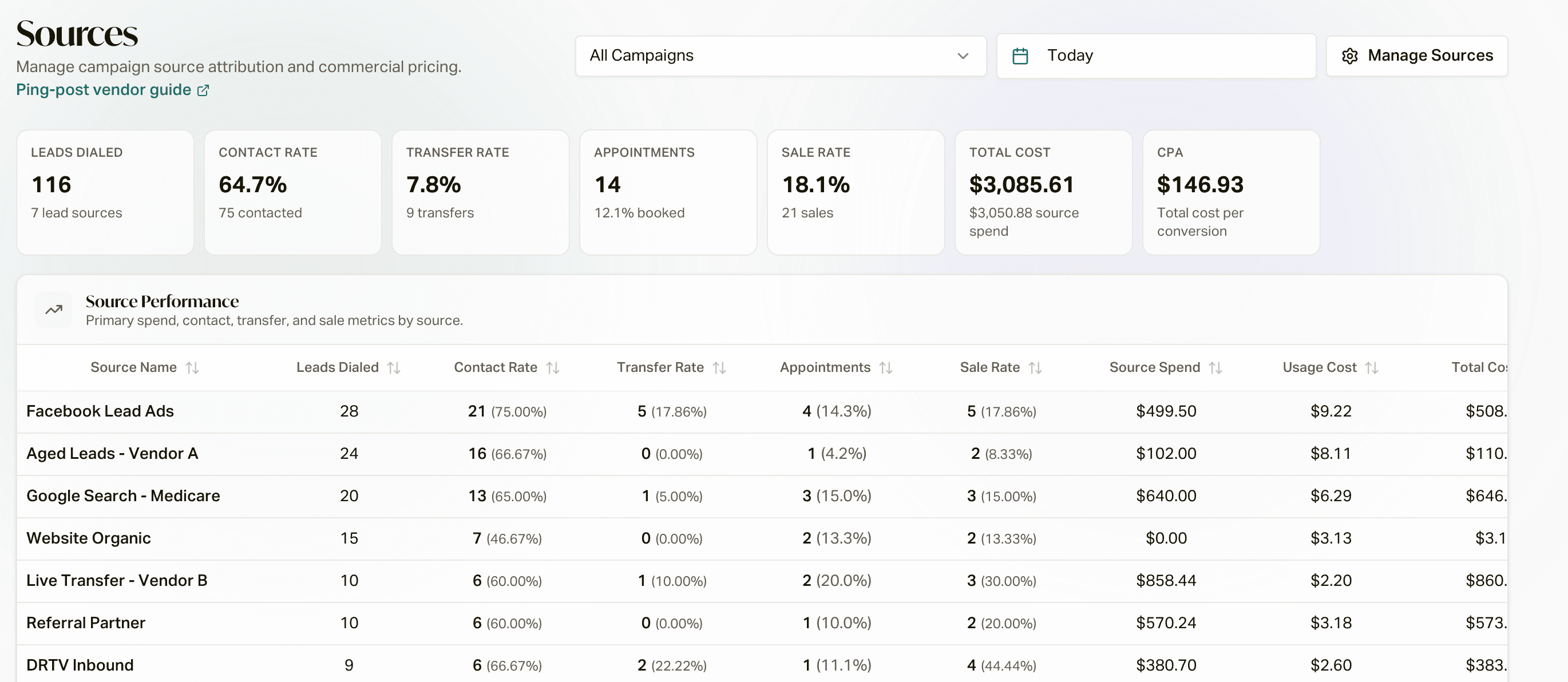
Source performance is available for campaigns with source activity (also available across campaigns from the Wallboard's Sources tab). Pick a date range (Last 24 Hours, Today, Yesterday, Last 7 Days, Last 30 Days, or a custom window) and compare vendors side by side inside the same campaign, where the script, hours, and routing are identical, so differences in results reflect the source itself.
What Is Tracked Per Source
| Metric | What it measures |
|---|---|
| Leads Dialed / Total Calls | Lead and call volume. Switch between Lead metrics and Call metrics for any campaign or the aggregate view. |
| Contact Rate | How often a dial reached the actual customer |
| Transfer Rate | How often a conversation was handed to a live agent |
| Appointments | Appointments booked, with booking rate |
| Sales / Sale Rate | Conversions: a policy created or a conversion recorded, tied back to the source |
| Billable Calls | Inbound calls that met the billing trigger (for example a duration threshold), with billable percentage |
| External Pending | External transfers whose outcome is not yet confirmed, so you can separate "sold" from "still waiting to hear" |
| Source Spend | What you paid the vendor, computed from the source's pricing model against billable activity |
| Usage Cost | Your careCycle usage cost for the calls attributed to that source |
| Total Cost and CPA | Spend plus usage, and total cost per conversion, the number that settles vendor debates |
Sources with ping traffic also get a Pings column tracking the full funnel: volume, accept rate, dialed, billable, and converted. See Ping-Post for the ping funnel in depth.
Four Ways to Slice It
The performance view breaks the same data down four ways:
- Source Performance: the primary spend, contact, transfer, and sale metrics by source, with a weighted-average totals row.
- Agent Performance: the same results grouped by assigned agent, with sales-share and transfer-share charts, so you can tell a source problem from a coaching problem.
- Disposition Mix: the outcome distribution by source. A vendor whose calls disproportionately end in Wrong Number or Do Not Call shows up here first.
- State Performance: the geographic distribution of source activity, with contact, transfer, appointment, and sale breakdowns by state.
How Attribution Works Under the Hood
careCycle keeps a per-source event ledger. Every meaningful moment (a lead ingested, a call started, a transfer connected, a disposition recorded, an appointment scheduled, a policy created) is recorded against the source, the campaign, the customer, and the specific call. Sales are counted when a policy or conversion is recorded for a customer attributed to the source, which is what makes CPA trustworthy: it is built from outcomes recorded in the platform.
Control Which Agents Take Which Sources
Live operations sometimes need a source turned off for a specific agent: a vendor sending junk, or an agent who should not take overflow traffic. Per-agent source restrictions live in the campaign's routing settings. Agents can always see which campaigns can ring them right now (live, paused, or off air) from the call-sources indicator in the top bar.
Sources Everywhere Else
Because source is a first-class field on calls and customers, it shows up across the platform:
- Calls: the calls list has a Source column and a source filter, and CSV exports respect it.
- Customers: filter customers by source, and the dashboard can chart customers grouped by their current source.
- Dashboards: the Acquisition view includes Leads by Source and Contact Rate by Source charts.
- Automations can filter on source, so a specific vendor's leads can enroll into their own campaign or be excluded from one.
Pre-Screen Inbound Calls and Track Your Sources
Have the AI answer and screen inbound callers from your ads and vendors, send the qualified ones to a licensed agent, book the rest, and see which sources pay off.
Ping-Post
Create sources, hand vendors their API keys, and see which vendors actually deliver the callers they ping about.