# Scripts (/docs/guides/campaign-toolkit/scripts)
A script is the script your agents see during a call: what to say, what to
capture, and in what order. Build it once, and every agent runs the same
compliant conversation, with the member's details woven into the wording and
everything they type saving straight to the customer record.
You manage scripts from **Configure** in the sidebar, under the **Scripts** tab.
Call forms are shared building blocks. One form can serve as your default for
every campaign, so the list shows where each form is used before you edit.
The default form cannot be deleted, and forms in use must be unassigned
first.
Create a Script [#create-a-script]
Click **New Script** and choose:
* **Blank Script** to build it from scratch.
* **Import from Document** to start from the script you already use. Upload a
Word document (.docx) or a text-based PDF under 15 MB, and careCycle turns
it into a script with pages and fields that you can review and edit.
Your first script is automatically marked as the org default; any script can
later be promoted with **Set as default** from its row menu.
The Editor [#the-editor]
The editor is a document: type your script, then press `/` for blocks and
`{{` for personalization variables. Changes save automatically (the cloud
icon confirms it), and **Jump to page** in the toolbar moves between pages.
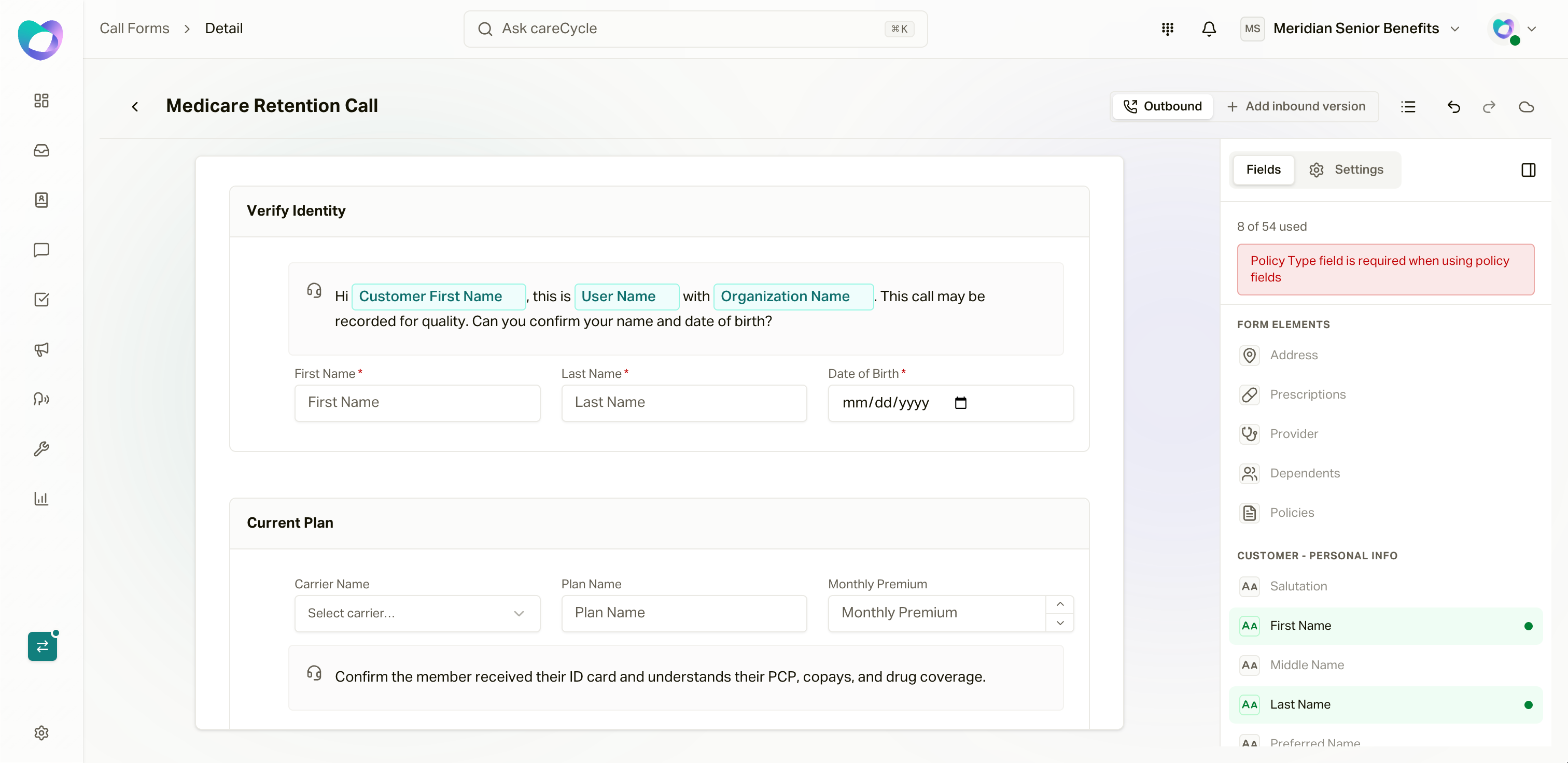 **Blocks you can insert:**
* **Script Block**: text the agent reads aloud. Drop in variables like the
member's first name or your organization name and they render filled-in for
the agent.
* **Audio Clip**: a recorded disclosure in a voice you pick. Type the
wording and click **Generate** to create the audio (with preview). On the
call, the agent clicks **Play** to play it to the customer, so the
disclosure comes out word-perfect whenever they use it. Turn on
**Required** for a consent the agent must play: they can't move past that
page until the clip has played all the way through to the customer (not
while the customer is on hold).
* **Form fields**: any customer field, plus your custom fields, inserted where
the conversation naturally captures them. Required fields block the agent
from advancing without them.
* **Smart form elements**: Address (lookup with autocomplete), Prescriptions
(medication, dosage, and frequency), Provider (search by doctor or practice
name), Dependents, and
Policies (create and manage one or more policies in place). Policy details
are captured through the Policies block, and the editor warns if policy
fields are used without a Policy Type.
* **Policies block fields**: the block always asks for the basics (policy
type, subtype, carrier, enrollment date, and effective date, plus plan code
and election period on Medicare policies). A new Policies block starts with
only these basics, and blocks added before you could choose fields keep
every field until you change them. Click **Add Field** for a list of extra
fields grouped by **Policy Details**, **Dates**, **Financial**, and more,
with hints like "Medicare only" for fields that only show on some policy
types. Click **Required** on an added field to make agents fill it in, or
the **X** (**Remove field**) to take it off. **Add All** and **Remove All**
do every field at once. On the call, **Add Policy** in the **Policies** panel
uses the same fields as the script, so agents see one consistent form.
* **Structure**: headings, lists, quotes, and dividers, plus **Jump Link**,
which takes the agent to a heading on any page.
Add fields [#add-fields]
The **Add to Script** panel on the right lists every field you can use and
marks the ones already placed with **In Script**. Click one to insert it at
your cursor, or drag it into place. ZIP, city, state, and county are listed on
their own too, for when you don't need the whole Address block.
Use **Search fields** to find one fast. If the field you need
doesn't exist yet, click **Create "your search" Field** right from the empty
search (or **New Custom Field**), and it's added to your
[custom fields](/docs/guides/reference/custom-fields) and the script at once.
A field can go in more than one place, like a date of birth you capture early
and confirm again at the end. Every copy shares one value, so filling one
fills them all. Click **In Script** to step through the copies. Smart blocks
like Address and Policies go in once.
Field settings [#field-settings]
Click a field to edit its **Helper Text** and whether it's **Required** in
the sidebar. You can also change its **Label** unless it's a built-in field.
**Type** and **Options** are read-only here. Change pick-list options in
[Custom Fields](/docs/guides/reference/custom-fields).
Arrange fields side by side [#arrange-fields-side-by-side]
Put up to three fields on one row, like City, State, and ZIP. Drag a field
next to another one, or use the field's **Layout** options: **Move Left**,
**Move Right**, **Place Beside Field Above**, or **Move to Own Row**.
Preview your draft [#preview-your-draft]
Click **Preview** to fill out the script exactly like an agent would, with
your unsaved changes. Click **Back to Editing** when you're done.
Script settings [#script-settings]
The **Script settings** menu holds two switches:
* **AI Auto-Fill Fields** lets the AI fill fields from the live call
transcript. It never overwrites values that already exist or that the agent
typed.
* **Add Inbound Version** (see [below](#the-inbound-version)).
On a call, a 5-digit ZIP also fills in an empty City, State, and County for
the customer's address automatically. County is filled only when the ZIP sits
in a single county.
Sections and Branching [#sections-and-branching]
Scripts are built from **pages**, and agents see one page at a time with
**Previous** and **Next**. Click **Add a new page** (the **+**) to add one.
At the bottom of every page, **After this page** decides where **Next** goes:
1. Click **Add rule**, then set an **If** rule about answers on this page or
an earlier one (equals, not equals, contains, is filled, or is empty, plus
greater than and less than for numbers and dates). Type a date as
mm/dd/yyyy or yyyy-mm-dd. Combine several with **And** or **Or**.
2. Pick the page to **Go to** when the rule matches.
3. Set **Otherwise go to** for everyone else: the next page or any page you
pick.
Rules are checked top to bottom, and the first one that matches wins. That is
how one script can send an existing customer down one path and a new one down
another, or handle both the interested caller and the quick decline.
Older scripts may still have show/hide conditions on their pages. They keep
working until you change any page's **After this page** routing, either by
adding a rule or by pointing **Otherwise go to** somewhere other than the next
page. That replaces all of the old conditions at once. careCycle tells you when that
happens, and you can undo it.
The Inbound Version [#the-inbound-version]
A script can carry a separate **inbound version**: choose **Add Inbound
Version** in **Script settings** to start it as a copy of your outbound script, then tailor it. Inbound calls
render the inbound version automatically; outbound calls keep the original.
Remove it and inbound calls fall back to the outbound script.
Which Form an Agent Sees [#which-form-an-agent-sees]
When a call connects, careCycle resolves the form in this order:
1. The **routing group's** assigned form, for softphone destinations
whose screen behavior is set to Script. This is how a complaint line and
a sales line show different scripts.
2. The **campaign's** assigned form (used when the customer is a Lead).
3. Your **default form**.
4. No form: the agent sees the customer details page instead.
Inbound or outbound direction then picks the matching version of whichever
form won.
What your agents experience when this form renders live.
Where per-destination form overrides are configured.
Add your own fields, then place them on forms.